Be Present | Cultivate Self
A How-To Guide for Life

I remember being transfixed by my grandmother’s typewriter.
The sensation of the keys, the sounds, the tap-tap-ding! rhythm, followed by the carriage return. Each press punched a letter into the ink ribbon and onto the page, leaving behind a tangible symbol that something had, indeed, taken place. I spent one weekend at her house playing with it after she brought it up to show me from her old basement office. Nostalgia flows strongly from this memory.
And now we have the Internet, bypassing the curse/miracle that was the home computer. There are many who bemoan the loss as it relates to what society calls progress, but I’m not one of these. I have appreciated those moments in my life that were more palpable, but going from appreciation to obsession becomes too often the course, and within this obsession, madness is born.
What am I talking about? Who knows. I like my computer and do not bemoan for a second that I’m not carrying around a typewriter. But I can also acknowledge that, in this way forward that we’ve all found, something has nonetheless been lost; something very valuable at that.
And that’s okay.
Being in the present is about constant adaptation. The past is comfortable for many because it grants the appearance of stability. The future is comfortable for many for the opposite reason, nothing is yet written, infinitely softer than the rigid stone of the established past. Everything is new in the future, even the old. There’s no memory in the future (wrong direction of time travel). There’s no accountability. That’s always further off in the future.
When the present is uncomfortable, we tend to drift towards the past or the future, and you can likely predict the nature of a person’s troubles based on where they take refuge. Then there are the combinations that make up things like steampunk, which reveal the genuine creativity of the human brain, and our desire to escape the present, no matter to where.
“[W]hat was said 50 years ago is different from 40 years ago, which is different from 30 years ago, which is different from 20 years ago, etc. And now we know a significant chunk of all of that ‘popular’ knowledge is/was incorrect. Or rather, unrefined.”
It’s a funny thing, what happens when you start looking to build your shelter in the present. For one, you learn very quickly that you can’t build a shelter. At least, not one that will last longer than a few seconds. The future becomes the present and dissolves into the past. So, that becomes the first lesson.
Stop. Just stop. Breathe.
Motivational speakers the world over have found way after way to criticize the same thing — lack of movement or forward momentum. Speech after speech in graduation season is full of reassurance that the student who is going on to their next big thing succeeded because they didn’t get stuck in the weeds, or stopped on the shore.
I think the counter to this is that wisdom knows the difference between sitting still and doing nothing. Like a hunter would.
So I’m going to try a different tack. I’m trying to get stuck here, stuck in the present. Chosen of my own accord to remain. Always hitting from a certain point of view.
Hamlet referred to the future, specifically one’s mortal future, as the undiscovered country (I learned this via Star Trek, only later did I read the source material), but I rather think the present is the truly unexplored frontier. Everything is changing constantly all the time. Nothing can be stored, for as soon as it is, that thing becomes the past. Nothing can be put away for a rainy day, that then becomes the future. And every single second of our existence brings our mortal future.
So instead, you become stuck with yourself, living in your own reality that you get to define, somewhere between Prime Video and Netflix. Somehow, the worst part about living in the present becomes the voice in each of our heads that screams in vile agony when your brain is without distraction. It isn’t practical (is it even possible??) to sit with your thoughts — in utter silence? Like a psychopath?
This is Water
In a former iteration of myself, this is where the David Foster Wallace language would come in, because regardless of the “litbros,” DFW has stuff to tell us, no differently from any other voice in the past.
For those of you who haven’t, I encourage you to listen to/watch this. It’s from a commencement address he gave back in 2005. This is whence came his timeless insight/warning: this is water.
I bring up Wallace here because this is one of the earlier moments that set me on this path, one of the earlier ways of thinking that resulted in me walking this path. So, as it appealed to me, I can only include it here because without it, I wouldn’t be where I am today.
How do we engage with our present? I think the answer to this question is different for every human, and each one of us will spend the rest of our lives figuring it out. I know that’s a frustrating answer. But learning to see beyond your frustration with such paradox is an important skill. And if you can’t see past it and do not wish to learn this skill, well — best of luck to you!
But it’s true. What works today won’t work tomorrow. What’s good today might be bad tomorrow. Just look at anything in any subject (like diet) and you’ll often find that what was said 50 years ago is different from 40 years ago, which is different from 30 years ago, which is different from 20 years ago, etc. And now we know a significant chunk of all of that ‘popular’ knowledge is/was incorrect. Or rather, unrefined.
So what do we do?
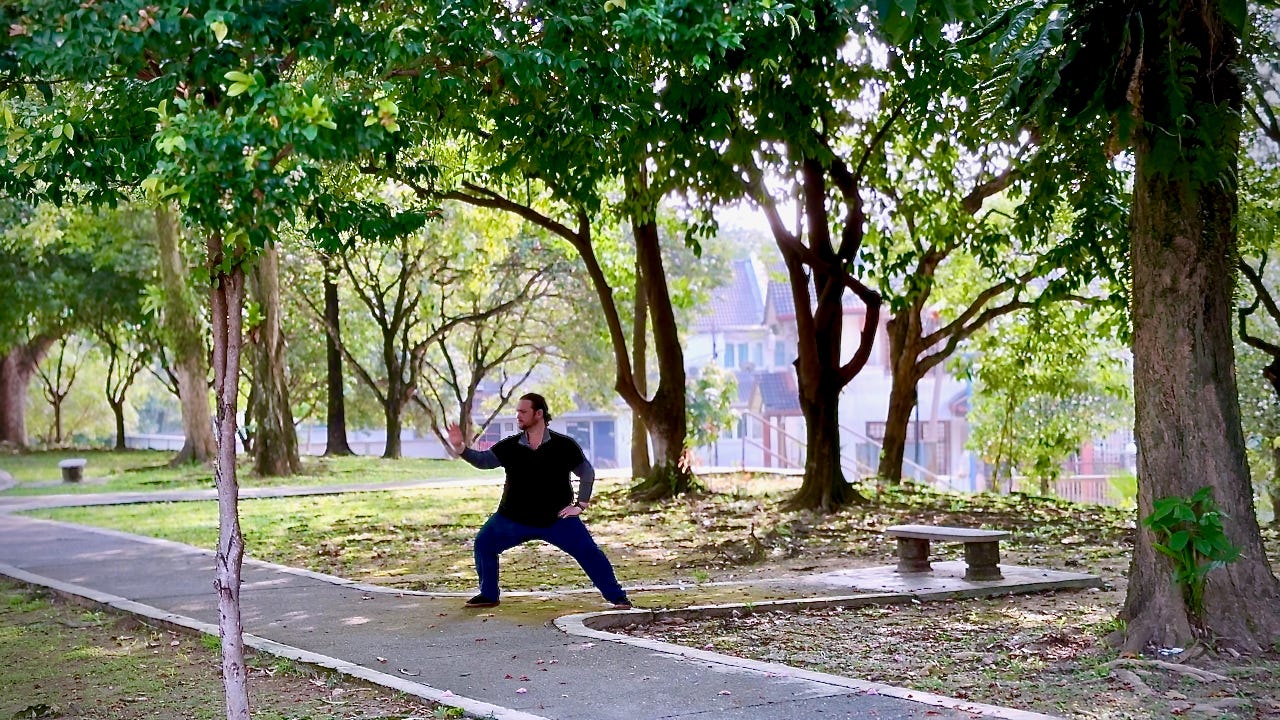
Well, a significant answer for me has come from simple meditation and a good moving practice like Tajiquan (Tai Chi).
Not workouts, not “hitting the gym,” not some fad to brag about. Not taking out my feelings on bouncing heavy rubber weights (at a gym that is called a “box”) when really what’s needed is therapy. None of this.
Like some might find in a church or temple, a moment to connect with one’s self and the universe at large.
It’s been said that this is the goal of a teacher — to bring students into harmony with the world, and if possible, into harmony with themselves.
Think of this like using a river to get from point A to point B. You can just jump in, get swept away by the current, hitting every bump, going down waterfalls, etc.
Or, you can take a canoe.
Jumping in is just as much harmony with the world as the canoe — you might get bumped around, cut up, bruised, etc, but you will get to point B.
But, taking the canoe is like finding harmony with the self. Both acts get you there in the end. But the canoe allows you to stay upright and mostly dry, no damage to your cell phone.
The canoe requires mastery of a system, a technique.
So in this, we learn two important things that related to achieving harmony: Presence and self-cultivation. You must be present on the river, aware of the world around you. But you must also cultivate your own self. You must learn practice skills like staying upright and rowing in a canoe.
Know this now — learning something is insufficient for its use. Practice is the only way to make learning useful beyond one’s own mind. Learn to use a knife but don’t practice knife skills? You cut yourself. Practice using a knife without being present? Same outcome.
As such, this has become my north star in life. I learned these phrases studying traditional Chinese martial arts. The philosophy and the ideas contained within have been discussed and curated over the past 2 millennia:
Be present. 在场 (Zài Chǎng)
Cultivate self. 修行 (Xiū Xíng)
Presence requires each of us to figure out how our unique perspective will allow us to expand beyond boredom, beyond distracting ourselves incessantly.
Side Note: I enjoy and get inspiration from great stories — film, books, television, whatever the source. So I use them. Doesn’t mean I think they’re real life. It means I learned something from them and believe they have ideas worth sharing, like the one below:
Self-cultivation requires work. It requires practice. Not like soccer practice as a child, but consistent and reliable practice. This is what is meant by the term kung fu. We’ve come to beleive in English that this term only means a certain type of martial art that came from the Shaolin Monastery. But, in reality, gōng fu (功夫) means “achievement/skill from hard work.” A great screenwriter from the Netflix series Marco Polo probably said it best through a character, so I’m going to simply let that explanation hold:
Gōng Fu. It means, 'supreme skill from hard work.' A great poet has reached gōng fu. The painter, the calligrapher — they can be said to have gōng fu. Even the cook, the one who sweeps steps, or a masterful servant can have gōng fu.
Practice. Preparation. Endless repetition. Until your mind is weary, and your bones ache. Until you're too tired to sweat, too wasted to breathe. That is the way — the only way — one acquires gōng fu.
– Hundred Eyes
And as is the case with whether or not the title character Marco Polo has acquired gōng fu, so it is with me: I decidedly have not.
Yet.
Becoming a practitioner is the work of a lifetime. In the meanwhile, be present and cultivate self.
Thank you for reading.
(Watch Hundred Eyes’ scene below!)